
Acupuncture for Low Sperm Concentration and Motility
Did you know roughly half of all fertility challenges involve male factor? Yet men are often left out of the conversation when it comes to assessment and what couples can do to improve their fertility. To help shift the conversation, this article looks at recent studies on acupuncture and sperm health, and how it may be a non-pharmaceutical option for male factor infertility.
Acupuncture Effect on Male Fertility
Acupuncture is a practice rooted in Traditional Chinese Medicine (TCM) that involves putting very fine needles into specific points on the body to prompt the nervous, hormonal and circulatory systems to respond.
Acupuncture compared with surgery - A randomised controlled trial (RCT) followed 30 men with primary infertility and a varicocele. Half had surgical repair and half received acupuncture twice weekly for two months. At six months both groups showed significant improvement in sperm concentration and motility, with both groups reaching a 33 per cent pregnancy rate [1].
Acupuncture compared with other natural approaches - A 2023 network meta-analysis gathered 27 RCTs covering 4,008 men and ranked non-drug treatment options for improving semen quality. Acupuncture showed significant benefit over placebo for total motility, and improved sperm concentration, placing it alongside omega-3 fatty acids, lycopene, CoQ10 and vitamins as non-pharmaceutical options for improving male fertility [2].
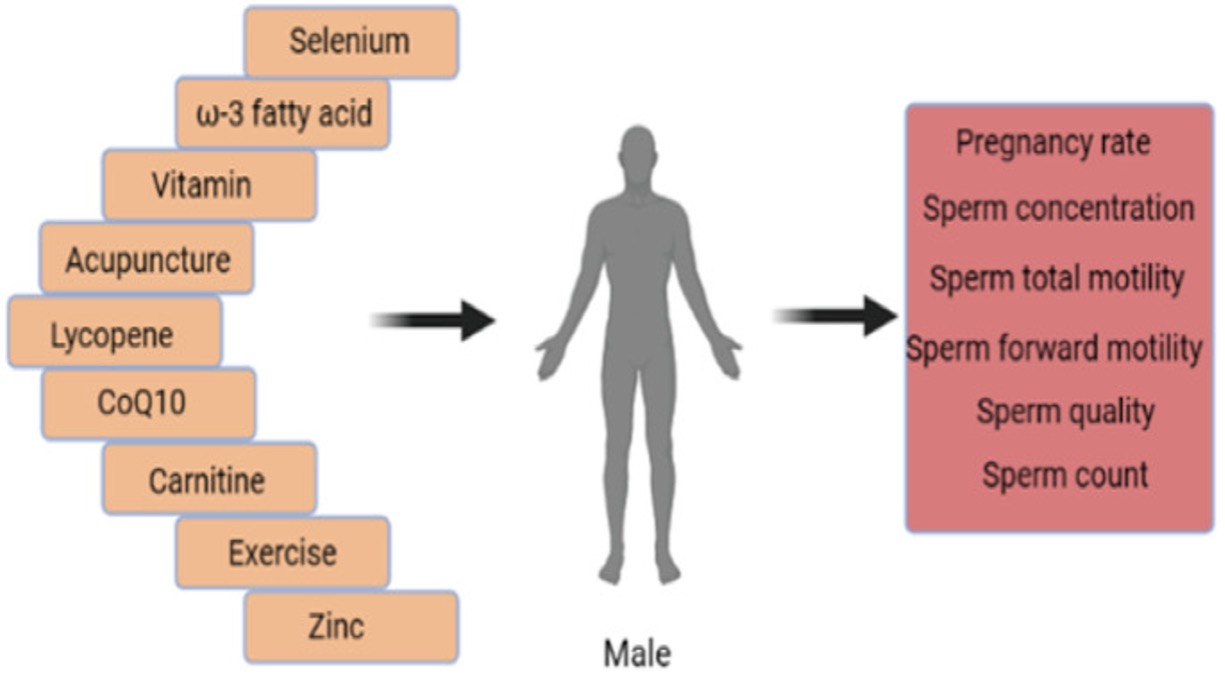
How acupuncture works - A 2022 review in Frontiers in Endocrinology looked at the mechanisms of acupuncture. Acupuncture acts through several routes at once: helping regulate hormone secretion, reducing inflammation, and improving semen parameters directly [3].
In practical terms, the leading explanations are:
- Hormonal signalling. Sperm production is governed by the hypothalamic-pituitary-testicular axis, a communication loop between two areas of the brain and the testes. Acupuncture appears to influence this signalling and support testosterone levels.
- Blood flow. Better circulation to the testes may improve oxygen and nutrient delivery to developing sperm and help clear excess heat, which is particularly relevant in varicocele.
- Oxidative stress. This is an imbalance where reactive oxygen species (ROS) outnumber the body's antioxidant defences and damage cells. Sperm are especially vulnerable because their membranes are rich in fats that oxidise easily. Reducing this load is thought to protect both motility and the DNA inside the sperm head.
- Inflammation. Chronic low-grade inflammation in the reproductive tract interferes with sperm production, and acupuncture has documented anti-inflammatory effects.
Why sperm health is a whole-body issue
Sperm quality is increasingly viewed as a window into a man's general health rather than an isolated fertility issue. A Danish study following 4,712 men found that those with a sperm concentration below 15M/mL had a higher rate of hospitalisation for cardiovascular disease, compared with men with more than 40M/mL. The overlap makes biological sense, the same factors that impair sperm, including oxidative stress, inflammation, insulin resistance and poor circulation, are the same factors that drive heart disease. A semen analysis at 35 is not only a fertility test but also an early indicator to look at cardiovascular health while there is still plenty of time to change the trajectory [4].
What Acupuncture Can Help With
Beyond reproductive health, acupuncture is used for chronic back and neck pain, headache and migraine prevention, nausea (including nausea in pregnancy), period pain and pelvic discomfort, and for sleep and stress during demanding treatment cycles.
What treatment is like. Sessions are typically 30 to 45 minutes. Needles are single use, sterile, and much finer than the ones used for blood work, so most people feel very little. Mild bruising or brief tenderness at a needle site is the most common complaint.
Where this leaves us
Acupuncture is low risk, well tolerated, and may be worth considering as an adjunctive therapy, alongside standard care from your fertility doctor. While we do see benefits in some studies, evidence has been mixed. This is why acupuncture is recommended to use alongside targeted effective treatments, such as antioxidant support, improving metabolic health, avoiding smoking and using medications as prescribed by your doctor.[5]
Interested? Click on the link below to book an introductory acupuncture session or ask about acupuncture during your next appointment and we can talk about whether it fits alongside your current treatment plan.
As always, in best of health!
Dr. Murphy
--> Book acupuncture at Conceive Health@Lakeridge HERE
References
- Kucuk EV, Bindayi A, Boylu U, Onol FF, Gumus E. Randomised clinical trial of comparing effects of acupuncture and varicocelectomy on sperm parameters in infertile varicocele patients. Andrologia. 2016;48(10):1080-1085. doi:10.1111/and.12541
- Chen Z, Hong Z, Wang S, Qiu J, Wang Q, Zeng Y, Weng H. Effectiveness of non-pharmaceutical intervention on sperm quality: a systematic review and network meta-analysis. Aging (Albany NY). 2023;15(10):4253-4268. doi:10.18632/aging.204727
- Feng J, He H, Wang Y, Zhang X, Zhang X, Zhang T, Zhu M, Wu X, Zhang Y. The efficacy and mechanism of acupuncture in the treatment of male infertility: a literature review. Front Endocrinol (Lausanne). 2022;13:1009537. doi:10.3389/fendo.2022.1009537
- Latif T, Jensen TK, Mehlsen J, Holmboe SA, Brinth L, Pors K, Skouby SO, Jørgensen N, Lindahl-Jacobsen R. Semen quality as a predictor of subsequent morbidity: a Danish cohort study of 4,712 men with long-term follow-up. Am J Epidemiol. 2017;186(8):910-917. doi:10.1093/aje/kwx067
- Jia W, Wang C, Yin Y. Acupuncture for oligospermia and asthenozoospermia: a systematic review and meta-analysis. Medicine (Baltimore). 2021;100(48):e27816. doi:10.1097/MD.0000000000027816
Stay connected with news and updates!
Join our mailing list to receive the latest news and updates from our team.
Don't worry, your information will not be shared.
